
The Biggest Disruption Yet
In nearly two decades of digital marketing, I’ve never seen disruption at this scale. Website traffic is dropping, even for companies doing everything “right” with SEO. The very metrics we’ve relied on to measure success are breaking down.
Mobile search, social media, and privacy policies each changed the game in their time, but none of them upended the funnel this quickly. Even Yamini Rangan, CEO of HubSpot, joked with a Seinfeld GIF in her keynote at the annual meeting of INBOUND about how fast things are shifting.
Things are so disruptive right now that it’s had me wondering, have we been getting it all wrong?
So what’s happening? New terms are emerging — “The Great Decoupling” and “The Crocodile Effect” — to describe a new phenomenon: impressions in Google search results are going up while actual clicks to websites are going down.
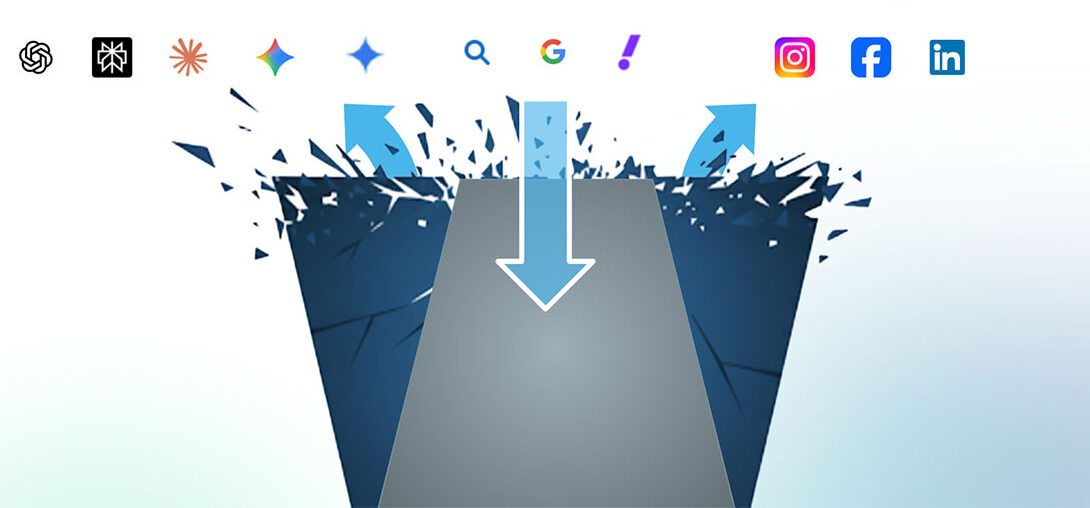
The culprits are clear: AI tools like ChatGPT, Google’s AI Overviews, and social platforms that lock content in their own ecosystems are rewriting the rules.
Marketers will look back on 2025 as both a challenge and an opportunity. Business leaders will remember it as the year they were forced to rethink how marketing drives growth. Personally, I couldn’t be more energized about what’s ahead.
SEO Isn’t Dead, It’s Different
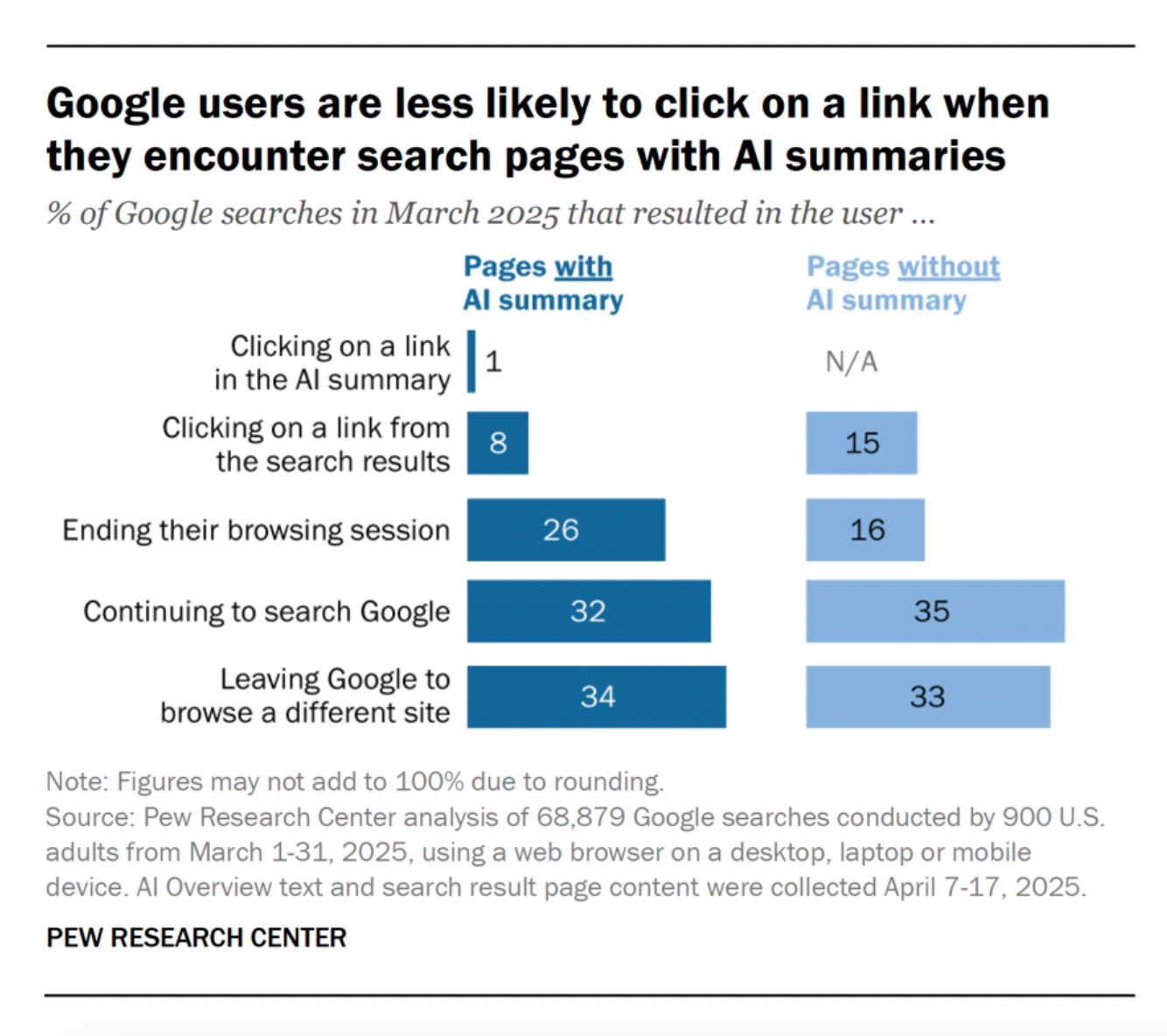
My social media feeds are full of claims that SEO is dead. People trying to capitalize on the chaos of the moment. But SEO isn’t dead– it’s evolving. A Pew Research report from July 2025 found nearly a 50% drop in clicks when AI Overviews appear.
That’s not a death sentence, but it is a wake-up call. The rules have changed, and “business as usual” won’t cut it. In this post, I’ll unpack what’s changed and what to do next to stay visible, credible, and competitive in the age of AI-powered discovery.
The Traditional Funnel: A Framework That No Longer Fits
The Buyer’s Journey: Awareness → Consideration → Decision
No matter how much the tools and platforms change, the fundamental buyer’s journey remains. People first become aware of a problem or opportunity, then move into consideration as they explore possible solutions, and finally arrive at a decision point where they commit to one path. This sequence is as old as commerce itself.
The Marketing Funnel
Marketers aligned content to each stage:
- Top of Funnel (TOFU / Awareness): blogs, guides, and content that help people recognize and define their challenge.
- Middle of Funnel (MOFU / Consideration): educational resources, case studies, and comparisons thatbuild trust and credibility.
- Bottom of Funnel (BOFU / Decision): testimonials,demos, pricing pages, and service content that help prospects choose with confidence.

For years, your website was the hub where all of this came together. A prospect might first land on a blog post, then click into your homepage, explore your About page, dive into a case study, and eventually fill out a form. Search engines, social platforms, and referral links all drove people back to this one central stage.
The Funnel Has Shattered
A month ago when I first started thinking about this blog post, I made this note: that model still matters but the funnel has shifted. I was trying to figure out how to adjust the funnel to fit today’s reality. I can’t do it, though.
The reality is, thinking about “a funnel” that all people go through in some way is obsolete. AI has personalized things to a degree that each person can make a very personal journey in minutes or hours, not days, weeks or months.
Your website is still important, but it’s no longer the center of the journey –
building awareness, educating prospects, and driving decisions.
Let’s look at some of these big changes.
What Broke the Marketing Funnel?
1. ChatGPT and the Rise of Answer Engines
Since the dawn of the internet, technology has shaped how people search, and we’ve adapted our marketing strategies to match. At first, all we had was a single search bar. We typed one keyword, got one result. Then came key phrases, then search intent, then context. Each time, marketers shifted how we created and optimized content.
But the latest shift isn’t just a smarter algorithm — it’s a whole new experience.
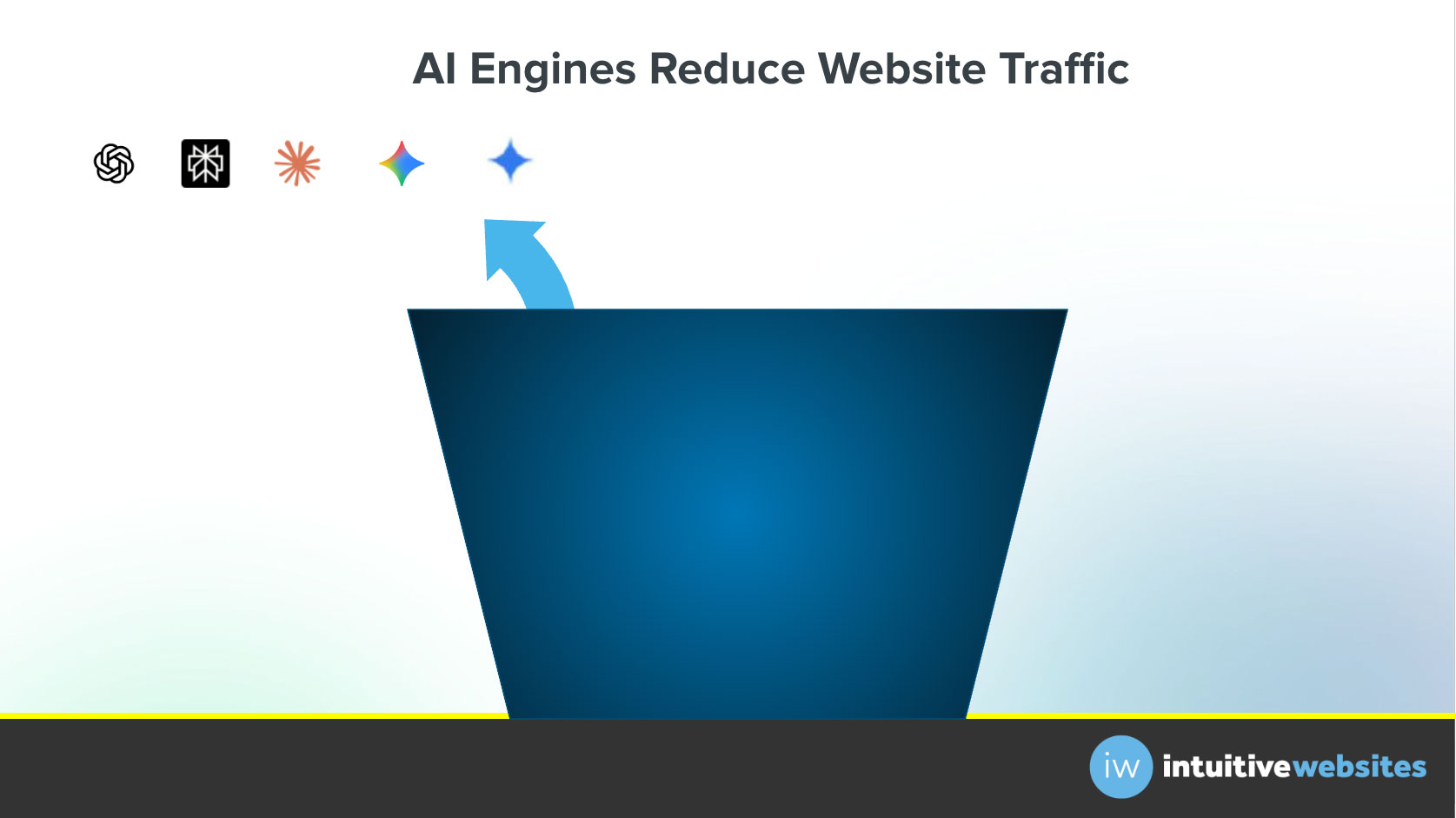
When ChatGPT launched in late 2022, it didn’t simply improve on Google. It changed the search process entirely. Instead of typing a query, clicking multiple links, scanning content, and piecing together an answer, you could ask ChatGPT and it would do the legwork for you in seconds.
That was the turning point.
The content you’ve built to attract customers is now being “borrowed” to answer people’s questions directly. You can actually fairly say that content has been stolen to create these AI platforms. Just last week Anthropic settled with authors to pay $1.5 billion for downloading unauthorized copies of books to train their AI model.
Your content may be cited in AI answers, but users have little reason to click through. That’s one impression, zero clicks.
We started seeing measurable ChatGPT traffic on our clients’ sites in early 2024, and the trend has only accelerated since. The broader market reflects the same pattern: by April 2025, ChatGPT was driving nearly 244 million visits to 250 news and media sites—almost double the traffic just four months earlier (Similarweb).
For some of our clients, this traffic is still barely noticeable; for others, it’s already a top 10 source — and we’ve started seeing new business come in from AI platforms.
But the bigger story is this: even when traffic is still rising, it’s rising more slowly, because more people are getting what they need without ever visiting your site.
2. Google’s AI Overviews and AI Mode
ChatGPT showed up one day and things changed. With Google the changes have been more gradual — until now. For years, features like “People Also Ask” and featured snippets chipped away at click-through rates, offering small answers right in the search results.
Google launched AI Overviews in 2024 and then AI Mode went mainstream in May 2025. We began to see a major shift in traffic trends with at least 25% of our clients that coincided with the AI Mode launch. For most websites, organic search traffic is their first or second highest traffic source. AI Mode, I think, could be the single biggest one time impact on website traffic since the modern browser was created.
3. Social Platforms Trapping Content
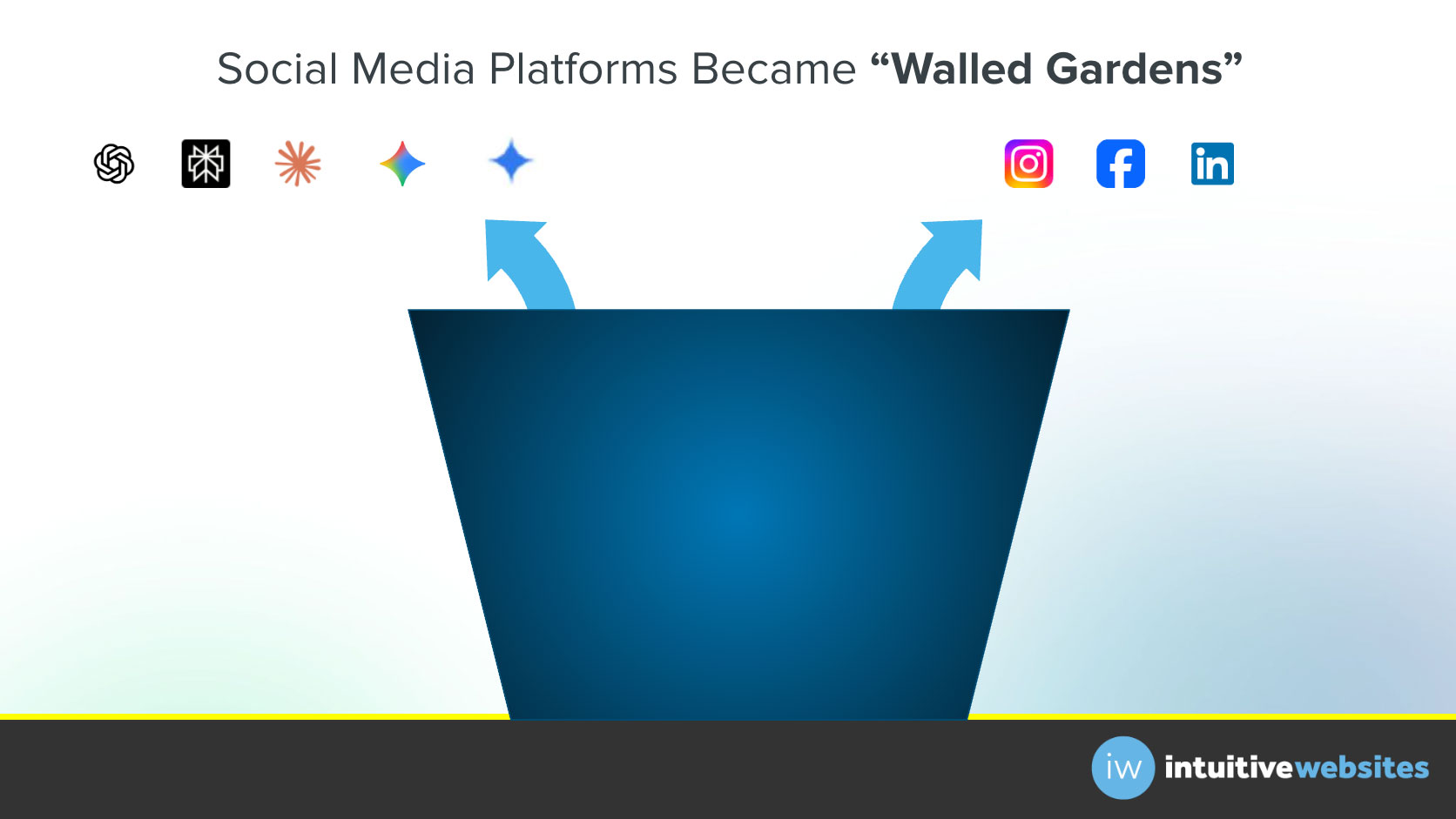
Meanwhile, social channels have stopped acting as traffic drivers. Stealing your content, taking away the need for users to click, and politely asking (okay, basically forcing) you to publish original content exclusively on their platforms. LinkedIn, Facebook, Instagram should no longer be seen as platforms that can drive people to your website.
As Amanda Natividad from Sparktoro points out, “A LinkedIn post without a link can earn 8x more reach.” While that may not be official research, the sentiment is shared across many LinkedIn influencers.
It used to be simple: share a blog post link, watch the referral traffic roll in. Now, LinkedIn prioritizes keeping users engaged on LinkedIn, because that’s where they make money from ads. Facebook’s organic reach is a shadow of what it once was. And Instagram posts are now indexed by Google, meaning your website content competes directly with billions of Instagram posts, some of them on the same topics.
In short: ChatGPT and Google are “borrowing” your content to keep users on their platforms, while social channels expect you to give them content with no strings attached. If you want reach on these platforms, it’s no longer about driving traffic back — it’s about publishing directly, natively, where the audience already is.
How the Buyer’s Journey Really Works in 2025
Behavior Has Changed Forever
The most important change isn’t just in the technology — it’s in how people behave because of it.
Buyers are no longer patiently moving step by step through a neat funnel on your website. Instead, they’re stitching together answers in real time across multiple platforms. They don’t need to read three blog posts and a case study before they’re “ready.” They can watch one LinkedIn clip, see an AI-generated recommendation, and skim a few reviews — and suddenly they’re confident enough to make a decision.

That’s not to say the journey has vanished. People still want to learn, compare, and validate. But now they’re doing it on their own terms, in a much more fluid way. Sometimes the entire process happens in an afternoon. Other times, they bounce between AI chats, social feeds, and a handful of web pages over a few days.
The part you used to control — the content sequence on your site — is shrinking.
The part you can’t control , the conversations happening on platforms you don’t own, is expanding. What you can do is show up consistently, with authority, in the places where buyers are piecing the journey together.
In this new reality, your influence comes less from pulling people into your funnel, and more from being present in their journey.
Where Decisions Happen Now
Decisions aren’t being made quietly on your website anymore — they’re being made in feeds, forums, and AI chats.
A LinkedIn comment thread can validate an opinion. A single AI-generated answer can shortcut hours of research. A Google snippet can build (or erode) trust in seconds. And a review on Reddit or G2 can outweigh ten carefully written blog posts.
The journey is fragmented, but the effect is unified: buyers feel more informed, more quickly, without ever stepping into your carefully crafted website funnel. That’s the new decision-making reality we need to design for.
What It Really Means to “Meet Buyers Where They Are”
“Meeting buyers where they are” isn’t just about cross-posting your blog to LinkedIn or dropping the same video on TikTok and YouTube. It’s about understanding the moment and the context in which decisions are forming.
It means:
- Publishing natively on social platforms, not just linking out.
- Creating content structured so AI tools can parse and resurface it.
- Thinking beyond clicks — measuring visibility, mentions, and influence as leading indicators.
- Accepting that credibility is built in fragments: a comment here, a snippet there, a podcast mention tomorrow.
The old funnel gave you one stage, your website, where you could control the narrative. The new reality asks you to participate in dozens of micro-moments where buyers are shaping their own narrative. That’s harder to manage, but it’s also a bigger opportunity if you approach it with consistency and clarity.
Search Everywhere Optimization: The New SEO
Beyond Keywords
You may seen the phrase Search Everywhere Optimization starting to surface in industry conversations. It hasn’t replaced SEO, but it captures the reality we’re facing: search no longer lives in a single Google box. Discovery now happens across AI platforms, social feeds, and search features that deliver answers before anyone ever clicks your site.
The foundations of SEO haven’t disappeared. If you’ve been doing it right, writing for your audience, not just the algorithm, much of that work still holds value. But its role is shifting.
Content is still king, but its kingdom has expanded. Blog posts, videos, LinkedIn updates, podcast transcripts—whatever the format, they’re all built on language. And those words don’t just attract clicks anymore; they act as signals of authority wherever people are searching.
If you focus only on traditional search rankings, you’ll fade. To stay relevant, your content must be findable in AI platforms, surfaced in social feeds, and structured for environments we can’t yet predict.
E.E.A.T.: The Anchor of Authority
Google gave us the framework of E.A.T. in 2014 and added another E in 2022 – Experience, Expertise, Authority, and Trustworthiness (E.E.A.T.)are what separate brands that get surfaced from the noise of AI-generated answers. AI can remix information, but it can’t replicate lived experience or authentic perspective. When you decide what content to publish, run it through the E.E.A.T. test. If it doesn’t pass, it probably isn’t worth doing.
GEO and AEO
New terms are popping up:
- Generative Engine Optimization (GEO): Making sure your content is in the source set AI pulls from when generating responses.
- Answer Engine Optimization (AEO): Anticipating conversational queries, thinking not just about the first question, but the follow-ups people will ask.
They’re good reminders, but really they’re just branches of SEO. And really, they’re different acronyms for essentially the same thing. Optimize your content everywhere it appears to be included in AI responses.
Formatting for AI and multi-platform visibility
This goes beyond keywords. It’s about making your content machine-readable and context-rich:
- Use schema markup to give AI and search engines structure to grab.
- Build clear Q&A sections, because that’s how many queries are framed in AI tools.
- Attribute content to real authors with bios, so expertise is visible and verifiable.
- Keep metadata clean and descriptive. Titles, captions, alt text, filenames all matter more when machines are reading.
Five Tactics to Make SEO Work Right Now
Here’s how we’re putting Search Everywhere Optimization into practice:
- Client interviews as content fuel. Ask natural, audience-driven questions (like people do in ChatGPT) and publish the answers in their own words.
- Voice-first content capture. Record thoughts on the go, transcribe, and repurpose them. The conversational tone performs across platforms.
- Generous content distribution. Don’t hoard everything on your site—push content out natively on LinkedIn, newsletters, and other places where trust forms early.
- AI-aware formatting. Use schema, FAQs, and structured language so AI tools can parse and reference you accurately.
- Repurposing for reach. One strong article can become a LinkedIn carousel, short video, podcast clip, and newsletter feature.
These tactics ensure your brand is present in the fragmented, multi-platform journey buyers are actually taking today.
The Next Move Is Yours
The funnel hasn’t disappeared. It’s just no longer yours to control. Buyers are moving through awareness, consideration, and decision faster than ever, often outside your website entirely.
That reality leaves you two options:
- Keep chasing clicks and watch your influence fade.
- Or adapt to where decisions are really happening, and earn authority in those spaces.
The fundamentals of marketing—knowing your audience, building trust, delivering value—haven’t changed. What’s changed is the urgency. The speed. The number of platforms where those fundamentals have to connect.
If you make this shift now, you’ll not only stay visible, you’ll lead. If you wait, you’ll be invisible by default.
Want a Clear Picture of How Your Website Performs in the Age of AI?
AI search is changing how buyers find you. Tom Young will personally review your site and send you a short, no-strings-attached video with practical tips to help you get found and connect with your visitors.
